 By FMTeam
 Many middle-class families in India take credit to buy various items, and it has become a normal part of life for many.
A home loan, personal loan, credit cards, or EMIs for vehicles or gadgets are no longer seen as unusual. The problem begins when borrowing becomes a dependence on credit.
Many borrowers don’t realize that they are in a debt trap until a large portion of their monthly incomes starts going towards EMIs.
At that stage, even a small financial hurdle could hurt a lot- like a medical emergency, job loss, or business slowdown, or the need for debt settlement. These events can push a household into serious financial stress.
Debt traps are rarely created by one bad decision. It is usually developed through a series of small financial habits. This guide will help you understand- Why debt traps are common among India’s middle class, Early warning signs you should not ignore, practical strategies to escape debt faster, etc. So, let’s break it down.
Understanding the Debt Trap
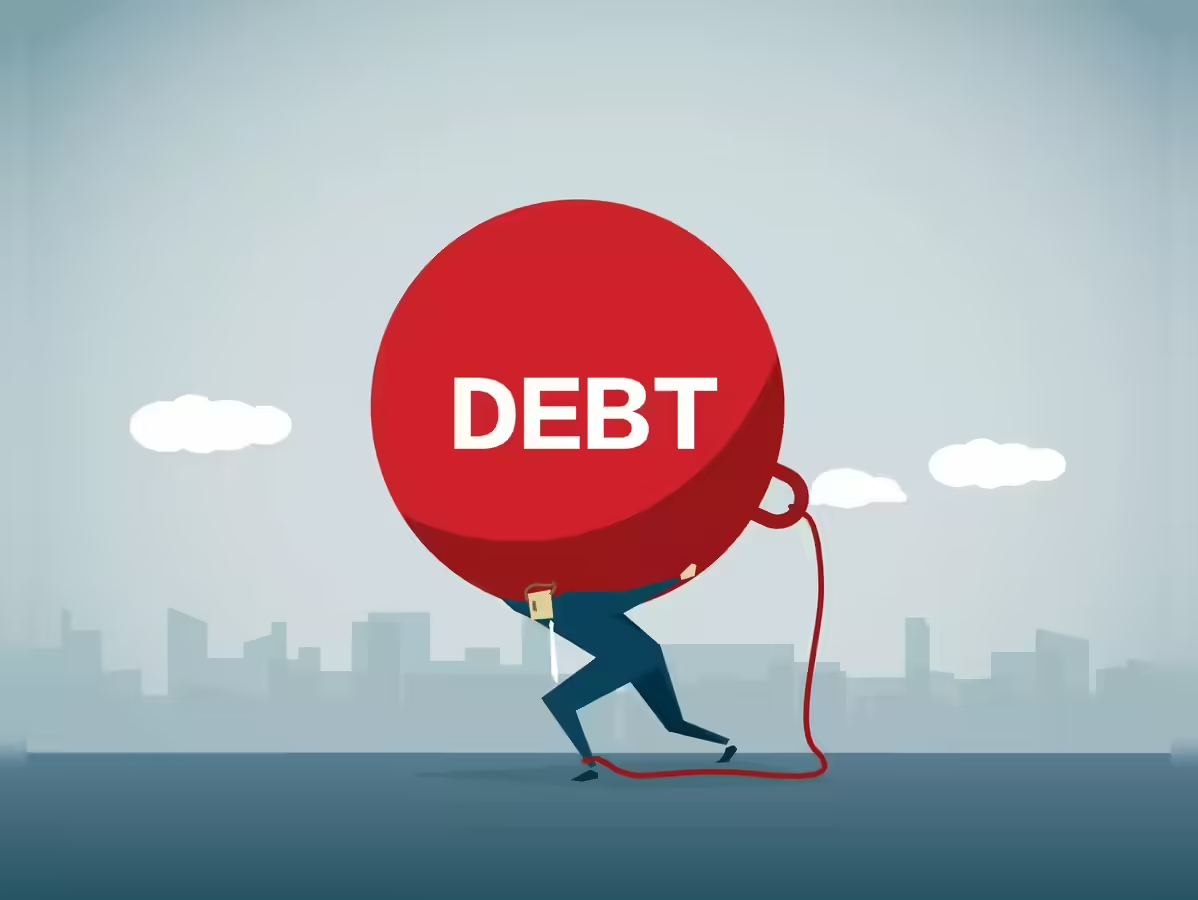
A debt trap happens when a person must take new loans to repay existing ones because their income is no longer sufficient to manage all these obligations.
This happens when EMI exceeds your comfortable repayment capacity and new bills are keeps on rolling over. Over time, borrowers feel stuck because interest compounds while income stays fixed.
Why Middle-Class Borrowers in India Fall into Debt Traps?
The Indian middle class faces these debt problems as it is a unique mix of aspirations, responsibilities, and financial pressures. Here are the most common reasons-
Easy Access to Loans & Credit Cards
The financial market has evolved into something where Banks, NBFCs, and Fintech Companies are aggressively providing market credits to others. Today, you can easily get various types of loans like Personal loans, Buy Now Pay Later, Zero-cost EMI Schemes, Pre-approved credit cards, etc.
The approval process is easy, and many borrowers underestimate the long-term payment burden that comes with it. A loan can look small today, but it can become a heavy burden when multiple EMIs are combined simultaneously.
Lifestyle Inflation
Incomes rise gradually, but spending often rises faster. This inflation in lifestyle often results in overspending, spending on useless things, which you buy to show off, etc. Here are some of the examples-
- Upgrading to a bigger house earlier than necessary
- Buying expensive smartphones and electronics
- Buying vehicles without comprehending financial standing
- Getting a credit card for luxury travel and paying a higher membership cost for that
The pressure to maintain a certain lifestyle, especially in urban India, often leads to consumption funded by credit rather than savings.
Lack of Financial Planning
Many households operate without a structured financial plan, without a defined budget, or any financial emergency funds. Here are some of the common mistakes:
- The household does not maintain an emergency fund
- No budgeting system
- Borrowing money without calculating the affordability
Financial planning is not about restricting life, but it is about ensuring your financial decisions today do not harm your future stability.
Credit Card Mismanagement
A credit card can be the biggest source of debt traps, which is why you should be very careful when it comes to managing your credit cards. One of the biggest problems with credit cards is that when you borrow money, instead of paying the full amount, you pay the minimum due.
This results in the accumulation of money, and the interest of 30-42% annually starts accumulating. The balance grows faster than expected, and you enter into a debt trap.
Unexpected Emergencies
Life is uncertain, and anyone can get into financial emergencies. Even financially disciplined families can fall into this debt trap due to various reasons like medical emergencies, Job loss, or Business losses, etc. Without emergency funds, loans become the only solution, and this results in piling up of loans.
Warning Signs That You Are Entering a Debt Trap
Some clear signs indicate whether you are entering into a debt trap or not. Here are some of the signs that you have to watch out for-
- More than 40–50% of your income goes toward EMIs
- You use one credit card to pay another bill
- You frequently convert purchases into EMIs
- You struggle to save money every month
- You delay payments or pay only the minimum dues
Practical Strategies to Escape a Debt Trap
The good news is that you can escape a debt trap, and with the right strategy and discipline, is to follow the strategy. Here are some of the most effective approaches used by financial advisors-
Start with a Complete Debt Audit
You can start with a debt audit. Find all the liabilities you have and put them into a table format as follows-
| Loan type | Outstanding amount | Interest rate | EMI amount | Remaining tenure |
Fill the table, and you’ll be surprised when they finally see the true cost of their total debt. Clarity is the first step towards control.
Stop Taking New Loans Immediately
One of the most crucial things is to stop taking new loans immediately or credit card debt. You should also avoid new cards, EMIs, etc. Just focus entirely on repayment and financial stability.
Use the Debt Snowball Method
The debt snowball method is the method that focuses on paying off the smallest loan first. You can do that by paying the minimum due on all loans first and then using the extra cash to close the smallest loan. When this loan finished target the next smallest debt.
Use the Debt Avalanche Method
Another effective method is the Debt Avalanche method, and it is one of the effective strategies to adopt. In this method, you prioritize loans with the highest interest rates and usually follow this: Credit cards> Personal loans > Consumer durable loans > Car loans >Home loans.
Consider Loan Consolidation
If you are managing multiple high-interest loans, you can consolidate all the loans to simplify the repayment. There are multiple benefits to this, which are as follows-
- Lower interest rate
- One EMI instead of several
- Better repayment discipline
However, consolidation should only be used with strict spending control.
Negotiate with Lenders
Most borrowers do not realize that lenders are actually very willing to restructure loans in favor of the borrower. You can expect some or all of these-
- EMI reduction
- Tenure extension
- Temporary moratorium
- Settlement options in extreme cases
If you are struggling with payments, it is better to communicate early rather than default.
Increase Income Sources
Reducing debt becomes easier if you have multiple sources of income. You can consider doing extra time in the office, freelance work, side business, consulting projects, etc. Even selling unused assets can help you with your loans.
Create a Strict Monthly Budget
Having a disciplined budget is the backbone of debt recovery. You can use 50-30-20 rules as a starting point. 50-30-20 rules-
- 50% essentials
- 30% lifestyle
- 20% savings or debt repayment
If you are in heavy debt, you can temporarily shift this to something like:
- 60% essentials
- 10% lifestyle
- 30% debt repayment
Short-term sacrifice leads to long-term financial freedom.
Build an Emergency Fund
Once the debt is reduced, your next priority should be to build an emergency fund covering at least 6 months of your expenses.
This protects you from falling back into debt due to unexpected situations. Escaping debt is important, but staying out of it matters even more.
Final Thoughts
Debt is not always bad. It is, in fact, one of the best tools to make yourself rich. But bad loans are bad, and you have to have financial literacy to understand what a good loan is for you and what is not. The danger arises when borrowing exceeds repayment capacity, and you are in big trouble.